
Pam Totah
Register , 2026
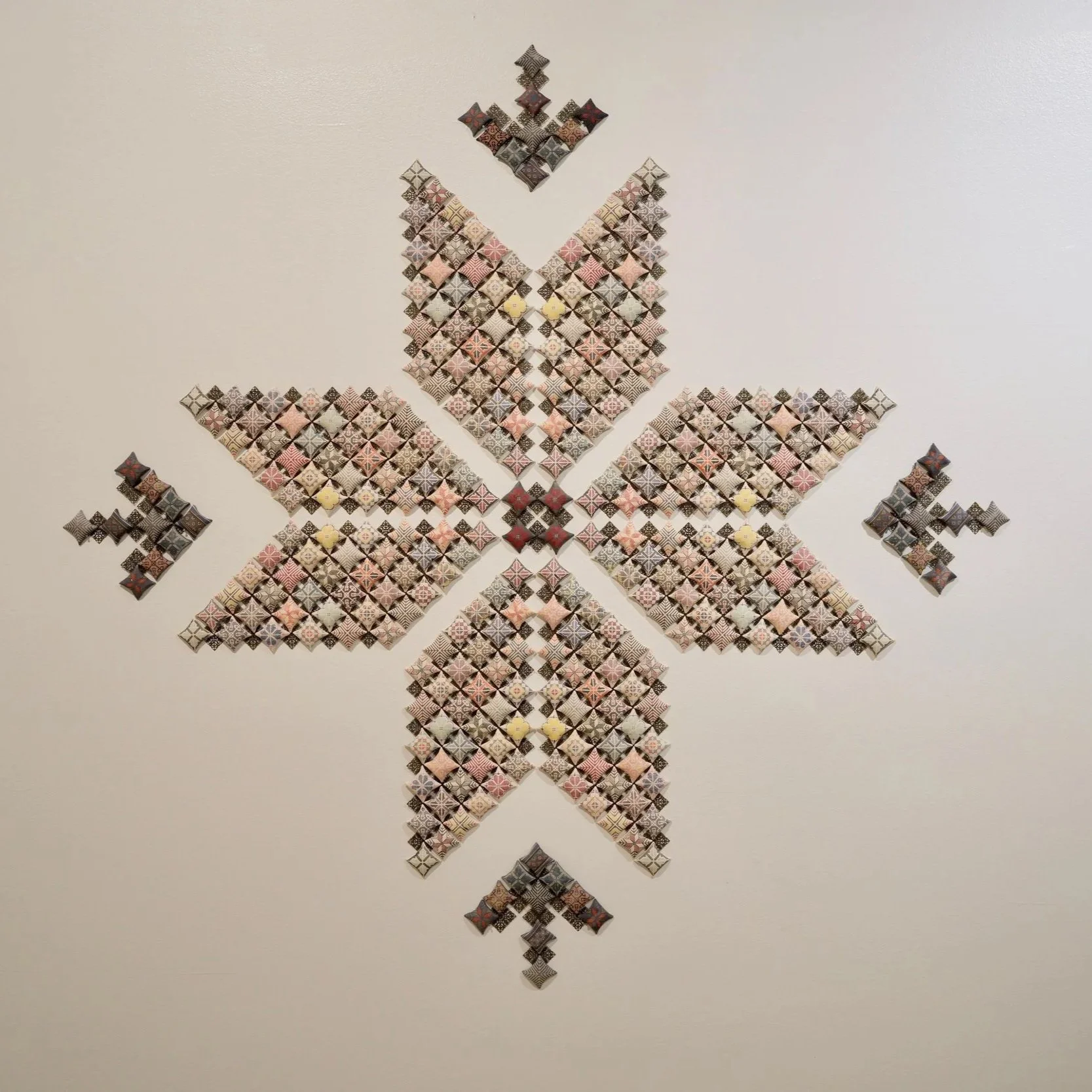
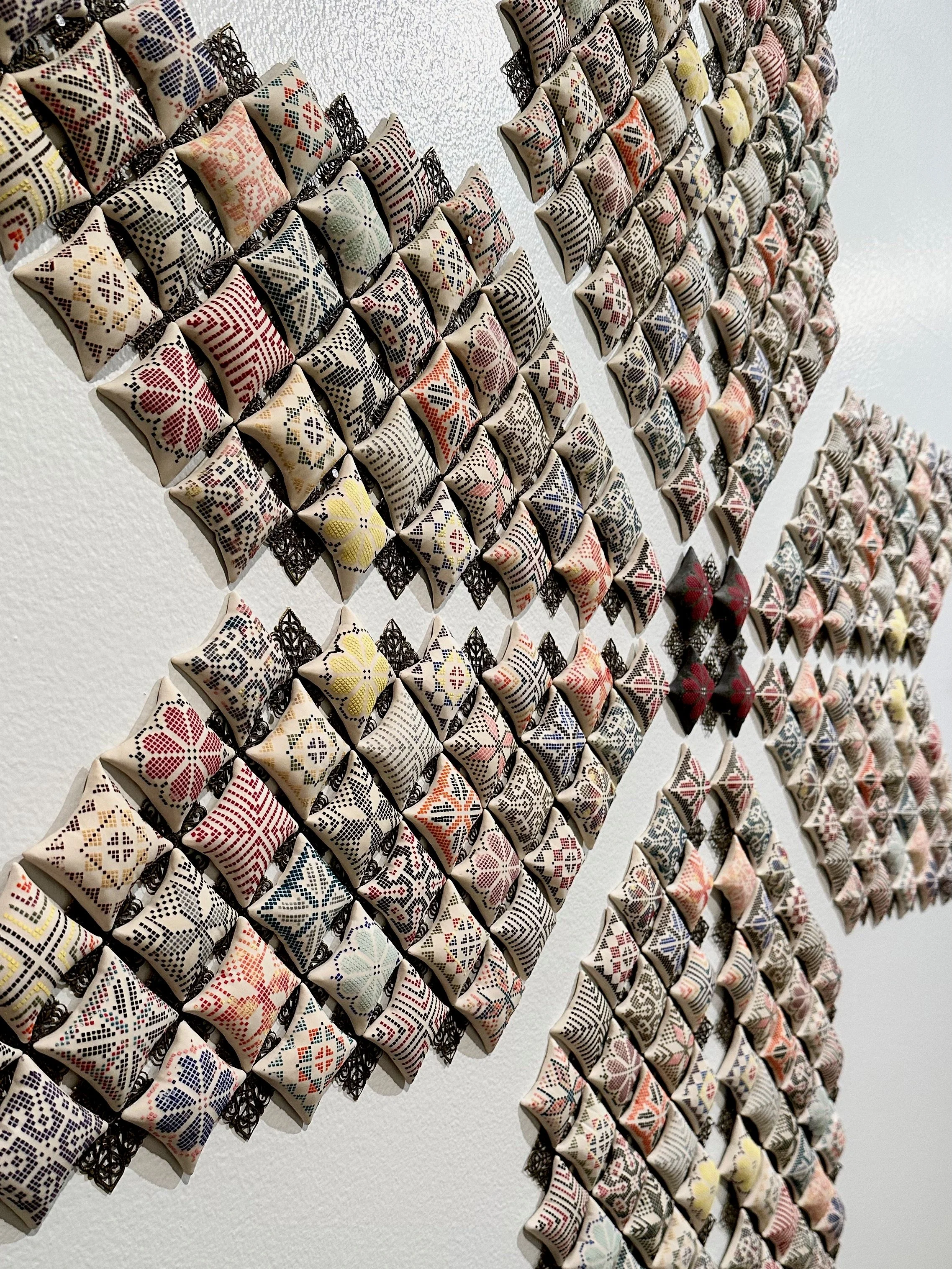
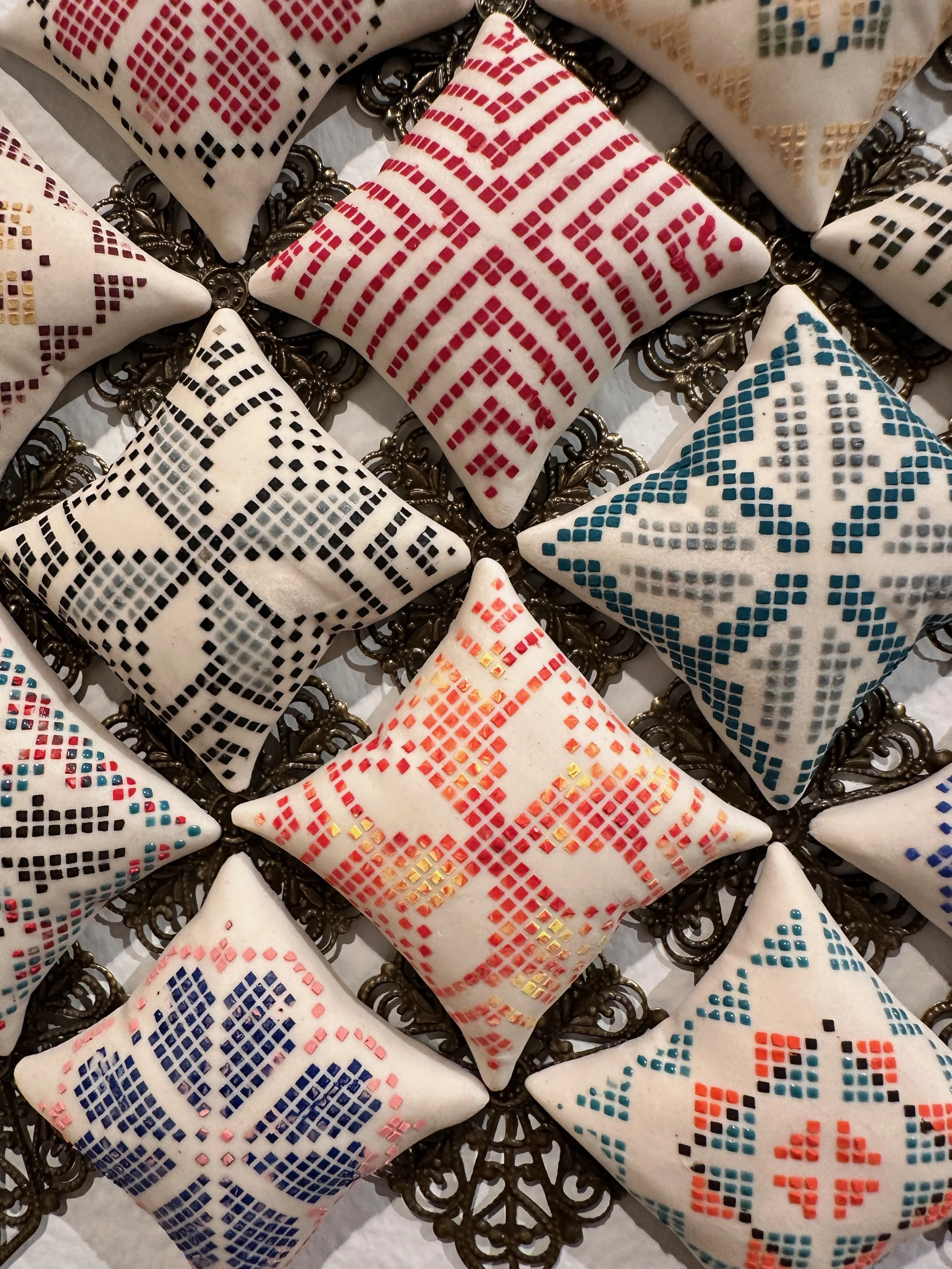
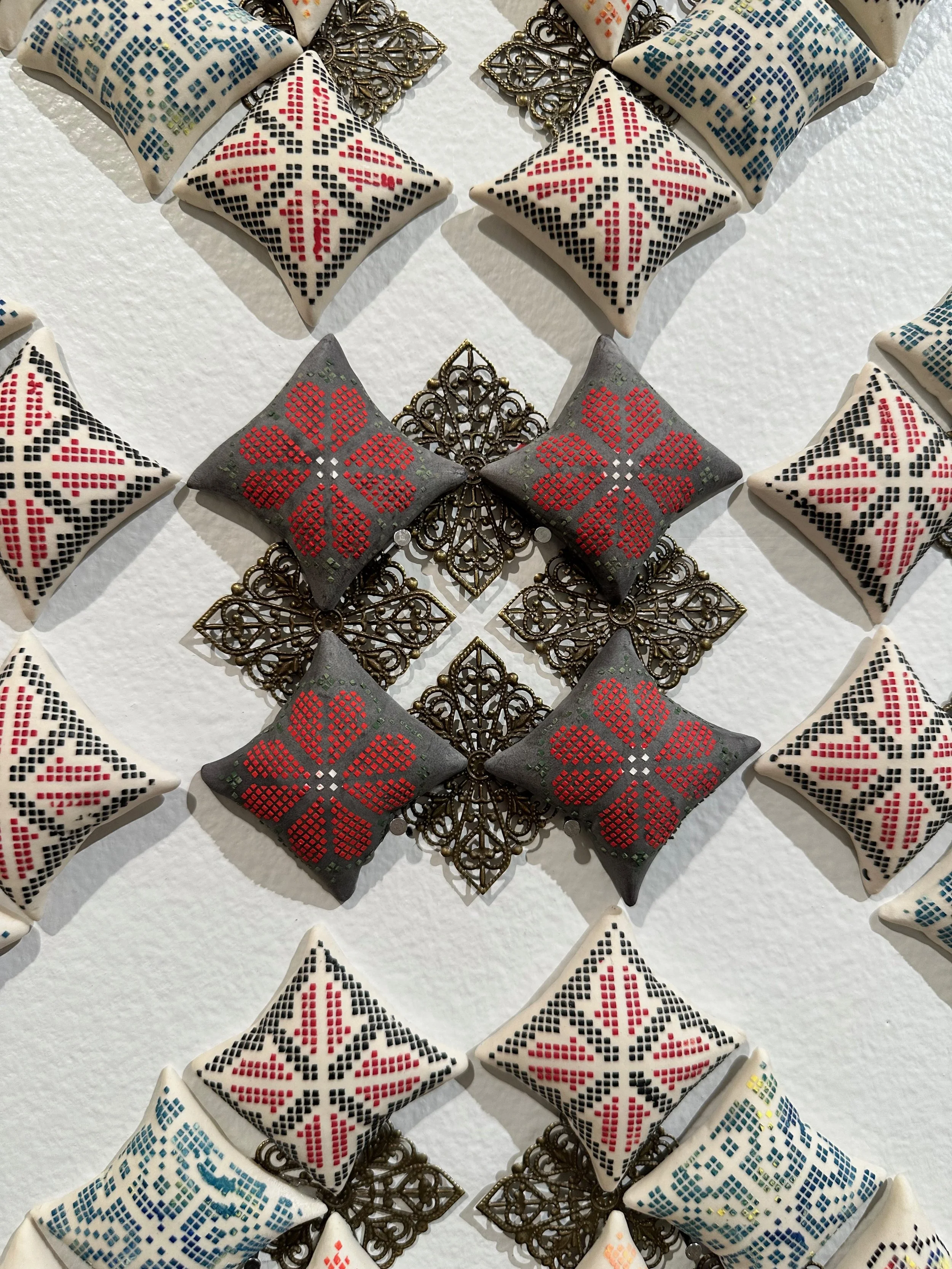
Porcelain, underglaze, iron
This piece started as a nod to my mother and her numerous tatreez (Palestinian embroidery) pillows. It was the countless colors and intricate patterns that first opened the door to my infatuation with tatreez and later inspired the ceramic work I do. The patterns on each of these 332 pillows were taken from ones she has at home.
The making of these pillows was after two and a half years of watching the Gaza genocide expand well beyond the borders of Palestine. That week it was in Iran and making pillows felt absurd, yet a needed way to use my hands, take my mind off the very things I would not stop thinking about. While excited to be making this piece, I was emotional and would myself breaking into tears periodically, remembering what was happening in the world beyond the doors of my small studio.
Somewhere around the forming of pillow 300, getting ready to clean up and head home for bed, something started repeating in my mind: The pillow is the register of our lives. The pillow is the register of our lives.
I thought it odd, as it was the first line in the last chapter of Mourid Barghouti’s book, I Saw Ramallah, which I had last read at least 20 years ago. Mourid Barghouti was a Palestinian poet who, in 1967, when Israel occupied the West Bank, was a student in Cairo. Upon trying to return home, he was barred by the Israeli occupiers from ever being able to return Palestine. He lived in exile most of his life until the Oslo Accords gave him an opportunity to visit Palestine thirty years later. I Saw Ramallah chronicled his journey home.
I went home that night and pulled out the book to read the last chapter:
THE DAILY DAY OF JUDGMENT
The pillow is the register of our lives. The first draft of our story that, each new night, we write without ink and tell without a sound. It is the field of memory that has been plowed and fertilized and watered in the darkness that is ours. Each person has his darkness. Each person has his right to darkness.
These are the scribbles that come to the mind without order, without structure. The pillow is our white cotton court of law, smooth to the touch, cruel of sentence. When it has received our heads, crowded with joy and contentment or loss and shame, the pillow becomes a conscience. The pillow is our daily Day of Judgment. A personal Day of Judgment for each one of us who remains alive. An early Day of Judgment that does not wait for our final entry to eternal peace. Our small sins for which no law takes us to task and that are known only to careful suppression spread out in the darkness of night in the light of pillows that know, pillows that do not keep secrets and do not care to defend the sleeper.
Our beauty, invisible to eyes spoiled by familiarity and haste, our worthiness, cruelly violated each day, are retrieved only here, and it is only because we retrieve them here every night that we are able to continue with the game. With life. The pillow claims nothing. A microphone may lie. Tender words of love, pulpits, figures, letters, reports, preachers, leaders, doctors, a mother—maylie. The pillow is woven out of truth. Truth as a secret, hidden by the calculations of daytime.
The defeated may claim victory and believe himself. When he puts his head down on his small pillow it tells him the truth, even if he should deny it. I did not win. He says it to himself without opening his mouth. And if he does not dare, the pillow will dare: you did not win. He may appear once again as a victor in public. He may be supported by some. But those some too will feel that cold tremor when alone in the night of their calculated positions and their patched-together support. The worth of life, the assertion of self, a feeling of pride, an adoption of one story rather than another—all these certainties assured by day, in the dust of the crowd, in the fever of competition and conflict, are turned by our pillows into hypotheses. The pillow is the misgivings that demand to be examined mercilessly.
Lying on my back in bed, my locked fingers cradling my head, I do not know what keeps my eyes open gazing toward the ceiling. The ceiling is no longer there in this complete darkness, but sleep has nothing to do with me. It was invented for others. This is my final night in Ramallah. My final night in this small room, under a window that looks out on countless questions, looks out also on a settlement. As though by crossing that small wooden bridge I managed to stand in front of my days. I made my days stand in front of me. I touched particular details for no reason and neglected others, also for no reason. I chattered an entire lifetime to myself while my guests thought I was silent. I crossed the forbidden bridge and suddenly I bent to collect my scattered fragments as I would collect the flaps of my coat together on an icy day, or as a pupil would collect his papers scattered by the wind of the fields as he comes back from far away. On the pillow I collected the days and nights of laughter, of anger, of tears, of foolishness, and of marble monuments for which a single lifetime cannot suffice to visit them all with an offering of silence and respect.
I prepare my small bag, ready to return to the bridge, to Amman, then Cairo, and then to Morocco to read poetry at a festival in Rabat. I will spend less than a week in Rabat, then return to Cairo, and then with Radwa and Tamim to spend the summer with my mother and ‘Alaa in Amman. In Amman I will wait for Tamim's permit. I will return here with him. He will see it. He will see me in it, and we shall ask all the questions after that. Tonight, with everyone in the house asleep and morning about to break, I ask a question that the days have never answered:
What deprives the spirit of its colors?
What is it other than the bullets of the invaders that have hit the body?
Connect with Pam:
https://instagram.com/totahstudio
https://share.upscrolled.com/en/user/d80dd1a6-013e-4fca-8b80-075c5ecf43a7